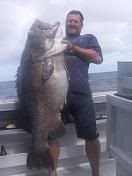
I agree Craig... I have tried the heavy handed approach and it just ends up an invitation to lose more gear, IMHO.
I don't use bloods anymore as I've found the good old triple surgeon's more effective on the slightly harder fluoro I prefer these days. In the clip shown the fish reefed me, not really an issue with any knot... The area you say gets the most attention is what I have also found to be area that gets the most abuse and so I still favor a straight leader tied with a guides Bimini to form a short double (6 inches if you want) at the butt. This is a pretty simple connection and so reliable I reckon every angler should learn it... you don't need toes and knees it should be done in the hands and even with my messed up teeth I can still manage to hold a tag end ...


It takes less than a minute to tie once practiced.
I used to use shock tippets in the belief that long protracted fights could cause wear on the tippets and I guess if I was chasing IGFA in small line classes this could be an issue but as I customarily use 10 - 15 kg straight leaders I find these adequate. Yes you get reefed, but that is something that will always happen to anglers fishing against such tough fish... for me, it's part of why I play the game.
The new DVD "Arbor to the Fly" which I am trying to finalize NZ rights for (The presenter is all go just trying to deal with the marketing company) has some exceptional solutions to these situations and they are from an angler who has held several world fly records including that for yellow fin (Recently broken in SA). The interesting thing for me with all of the "fancy" knots around is that the good old triple surgeon's, the simplest of all knots next to a granny, is still the best, by test, for joining two different diameter lines, especially fluoro. I liked this because it's simple, but more so because I found the Albright somewhat unreliable in Fluoro or hard mono, same for the clinch and blood.
I have used the triple surgeons on GSP backing to form a loop and then doubling again as advocated by Kevin and it certainly makes a strong connection but can, I find, dig into the coating of a fly line on a protracted fight with big fish and is a nightmare to extract off braided loops. I would still use it if I had to re rig on the water but do prefer braided loops for virtually every connection from backing to line and from running lines to shooting heads right through to the end loop to attach a leader to. I like Gudebrods black braid for this as it you get less issues with cuda's whacking the white loop which can be most annoying... You can color your loops using a permanent marker though and it does disguise them well for a while.
The new method I am using to rig the loops on GSP backing is the best I have seen and also comes from the DVD... I will try to explain but I fear it might sound more complex than it really is... it's simple and gives a durable 100% connection that doesn't bite into a line... and will last for years...
Make a 50lb or 35 lb braided loop (Depending on the lines you plan to fish on this rig.) No need to do anything to lock the loop at this stage... that comes later.
Using a piece of tippet wire fold it and push it into the braided loop above where the two sections of braid intersect. Push this down so it comes out of the tag end of the braided loop. Place the braid through the wire loop giving yourself heaps of tag to play with. Pull the braid up the center of the loop and out the entry hole.... This will give you a braided loop with a loop of GSP next to it. Pass the braided loop through the the GSP 5 times and place onto a nail or hook on your rigging bench. Now the best bit... Pull with even pressure on both sections of the GSP and it will seat down in a 100% connection over the braided loop (Similar to a nail knot) with absolutely no chance of it coming apart... this had the added effect of not only securing the two together but the knot locks the braided loop in a way it can never come apart. Using the tag end of the of the GSP to then do a series of half hitches over the end of the braid and finish with a five turn risutto finish (Fyfing) and you have an amazing smooth connection. You can whip it if you wish but there is no need. You can then also seal the whole thing with something like thinned shoe goo or Rio Knot sealer....
I know it's hard to describe these things and if I've made it unfathomable I apologise... you'll just have to wait to see it in person or on the DVD.
Simple is best! I don't think you have to worry about fishing outside of IGFA Ian... In trout fishing (The foundation of fly fishing) virtually no one fishes to IGFA and no one considers anything "cheating" I think though, that this is a personal thing and what you feel comfortable with is what you should do. That's very much a personal thing I believe and should exist in everyone's fishing world...
All in all the final thing is to use knots and rigs you personally have faith in and leave it at that. Resign yourself to the fact many of these fish will absolutely dust us... that for me is the attraction of this side of fly fishing.
In trout fishing most of the fun for me is in fooling the fish, once it has taken the fly the thrill is there and the fight is secondary, especially dry fly fishing to browns, my favorite aspect. With most SWF situations I don't get the same thrill from fooling the fish as I believe it is easier to do, in general, in the salt than the fresh, but the fight is exhilarating and Adrenalin producing and that, by God, will do me!

This is another personal aspect and may not be viewed or felt that way by others.
I also think both methods of fighting fish are valid. Morse's "Give no line" philosophy is valid and works in many situations but so is Craig's advocated softly softly approach, again in the right situation. It will depend on the fish and the circumstances and if you watched either of these "guru's" in action you will find they will use many methods in different situations and on different fish, it just takes experience to know when you will do what. Even the experts don't get it right every time... again part of the appeal I have no doubt.
Mathisen... if you are chasing IGFA off the rocks, especially if you are on the East Cape, you should give Mark Draper a yell. He is responsible for world record Kings off the rocks down there (Up to almost 50lb) and is, without question, the most successful by results, SWF guide in New Zealand, (he absolutely dominates the Yellowfin Fly captures in NZ). He does very little guiding now except for his old clients if he has time and spends the rest of his time on his Passion fruit Orchard. Personally having concentrated my efforts land-based around the Coromandel, if I was chasing IGFA I would be looking for the right terrain as opposed to the right leader... I have one ledge that has good numbers of Kingies (Generally get shots at 3 - 6 a day if lucky) and while the shore is rocky most all of the bay is sand and there is little structure to get reefed on. Long runs are the norm and softly works best as they tire themselves out dragging the line round.
Now I've moved it's only about an hour from home, as opposed to four hours for me last summer (Was still there almost weekly for a while

) so I plan on spending plenty of time there this summer... maybe I will tie some IGFA leaders after all...
A word of caution in NZ about purchasing the Byford Leaders. While they are wonderful works of art etc I understand there has not been a new shipment in NZ for over 6 years, maybe 10... As they are mono this is well past their shelf life... While I love the workmanship of them I wouldn't trust one... unless I knew it was new.... Then I would unquestionably.
As always, others mileage may vary....


 mathiesen wrote:
 Not sure how fair this is but to catch a 30Kg + fish is going to take a fair bit of effort. Dont want to give it to much opportunity to head for cover. The rod will be a 14 to 17 weight.



 Forum Topics
 New Posts
 Search
 FAQ
FAQ Register
 Login
Login


 Topic Options
 Post Options
 Likes(0)