 Olfart wrote: Olfart wrote:
NZfrnd: I only have a standard bilge pump on my tub (Buccaneer 510) controlled by an on/off switch. So was thinking it might be good to add a float switch (about $29) just to be safe in case of an unwanted ingress of water....e.g. from a leaking bung for example...
But then again, maybe a complete unit like you have may be a better option. |
The 'normal' way of wiring bilge pumps is either completely manual (i.e. switch on/off) or auto/manual/off.
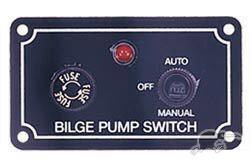
The wiring for the auto manual and off (2-way) circuit is pretty easy, you need a 3-position switch usually 1-off-2 where you would make 1 auto, off off (obviously) and 2- manual-on. The wiring is as this, common negative to battery from bilge pump, positive supply to switch (fused), two wires - one from each of poles 1 and 2 from the switch to the bilge pump. Wire 1 runs through the float switch, wire two runs direct to the pump.
This way, if the float switch fails to close (not uncommon as they are notoriously unreliable beasties) you still have a manual override position so that you can lock the pump on and pump out, and if the float switch fails to open (pump refuses to switch off) you can manually switch the pump off and prevent it burning out...
The bilge alarm horns are a requirement for survey and are usually permanently wired up on a seperate float switch (positive wire to fuse-horn-float switch and neg to battery) so that they cannot be switched off by accident. The second alarm float is normally positioned about 100mm or so ABOVE the bilge pump float switch to provide room for the bilge pump to operate without triggering the alarm/horn, and so that boat rolling won't trigger the alarm either.
Other considerations with fitting a bilge pump, include putting it somewhere that you can get to it to clean fishing line and debris out of it and service it, and placing the outlet as high up out from under the gunwales as you can. If there is a long outlet hose, and a small bilge compartment you might need to use a non-return to prevent the water in the hose backflooding through the pump into the compartment and closing the float switch again. This cyclic on/off due to water movement into and out of the hose has sunk several boats due to burning out pumps and flattening batteries. It's a good idea to fit a non-return in any event to prevent any crap that makes it through the pump from draining back through and stopping the works...
Under NO CIRCUMSTANCES should a bilge pump outlet exit below the waterline, as the skin fitting can clog with fouling or the non-return fail and a siphon set up which can sink your boat...
As far as a 'sealed compartment' that fills up, I would look to getting it repaired at the earliest and the cost depends entirely on the amount of damage. Or, fit a through-bulkhead hose fitting with sikaflex so that it remains sealed, and a decent watertight hatch with a gland to run wiring etc so you can get to the pump...


 l
l



 Forum Topics
 New Posts
 Search
 FAQ
FAQ Register
 Login
Login


 Topic Options
 Post Options
 Likes(0)


